Produce advance competencies in:
- Leadership and Innovation
- Creative Works
- Good Governance
- Development of Economic and Environmental Security
- International Relations
- The Promotion of Filipino Culture, Religious Diversity, and Nationalism

This Sustainability Framework articulates Bicol College’ commitment to advancing the United Nations Sustainable Development Goals (SDGs) to 2030 through instruction, research, extension, and institutional governance. It reflects the College’s role as an academic institution shaping ethical leaders, resilient communities, and sustainable futures.
Bicol College advances sustainability as a core institutional responsibility—integrating ecological stewardship, quality education, ethical governance, digital innovation, and community well-being across all academic programs. Guided by the United Nations Sustainable Development Goals (SDGs), the College ensures that learning, research, and service respond meaningfully to local, national, and global challenges.
Our sustainability initiatives are organized into six Sustainability Impact Domains (SIDs) that align academic excellence with social responsibility:
Ecological and Climate Resilience Sustainability – Promoting environmental protection, disaster resilience, and responsible resource management through sustainable tourism, policy studies, and environmental education.
Quality and Inclusive Education Sustainability – Ensuring access to equitable, inclusive, and future-ready education through teacher development, curriculum innovation, and lifelong learning.
Peace, Justice, and Ethical Governance Sustainability – Advancing the rule of law, public accountability, and ethical leadership through criminology, political science, law, and governance studies.
Sustainable Economic and Entrepreneurial Development – Supporting inclusive growth, green entrepreneurship, financial responsibility, and innovation-driven enterprises.
Digital and Knowledge Sustainability – Fostering ethical digitalization, information equity, cybersecurity awareness, and open-access knowledge systems.
Community, Culture, and Social Well-Being Sustainability – Strengthening social cohesion, cultural heritage, wellness, and civic engagement through community-based research and extension.
Through these domains, Bicol College prepares graduates who are globally competitive, socially responsive, and sustainability-oriented
The Bicol College Sustainability Impact Map visually represents the institution’s commitment to integrating the United Nations Sustainable Development Goals (SDGs) across its core values, programs, and initiatives. At the heart of the map are the guiding principles of Integrity, Excellence, Leadership, and Compassion, which drive the college’s approach to education, community engagement, and institutional governance. Surrounding these core values are six key focus areas—Ecological and Climate Resilience, Quality and Inclusive Education, Sustainable Economy and Entrepreneurship, Community and Social Well-Being, Digital and Knowledge Sustainability, and Peace, Justice, and Governance—each aligned with specific SDGs that reflect Bicol College’s holistic vision of sustainable development. By connecting these focus areas with concrete SDG targets, the map underscores the college’s commitment to fostering a culture of responsibility, innovation, and inclusivity, preparing students not only for academic success but also for meaningful contributions to society and the environment.
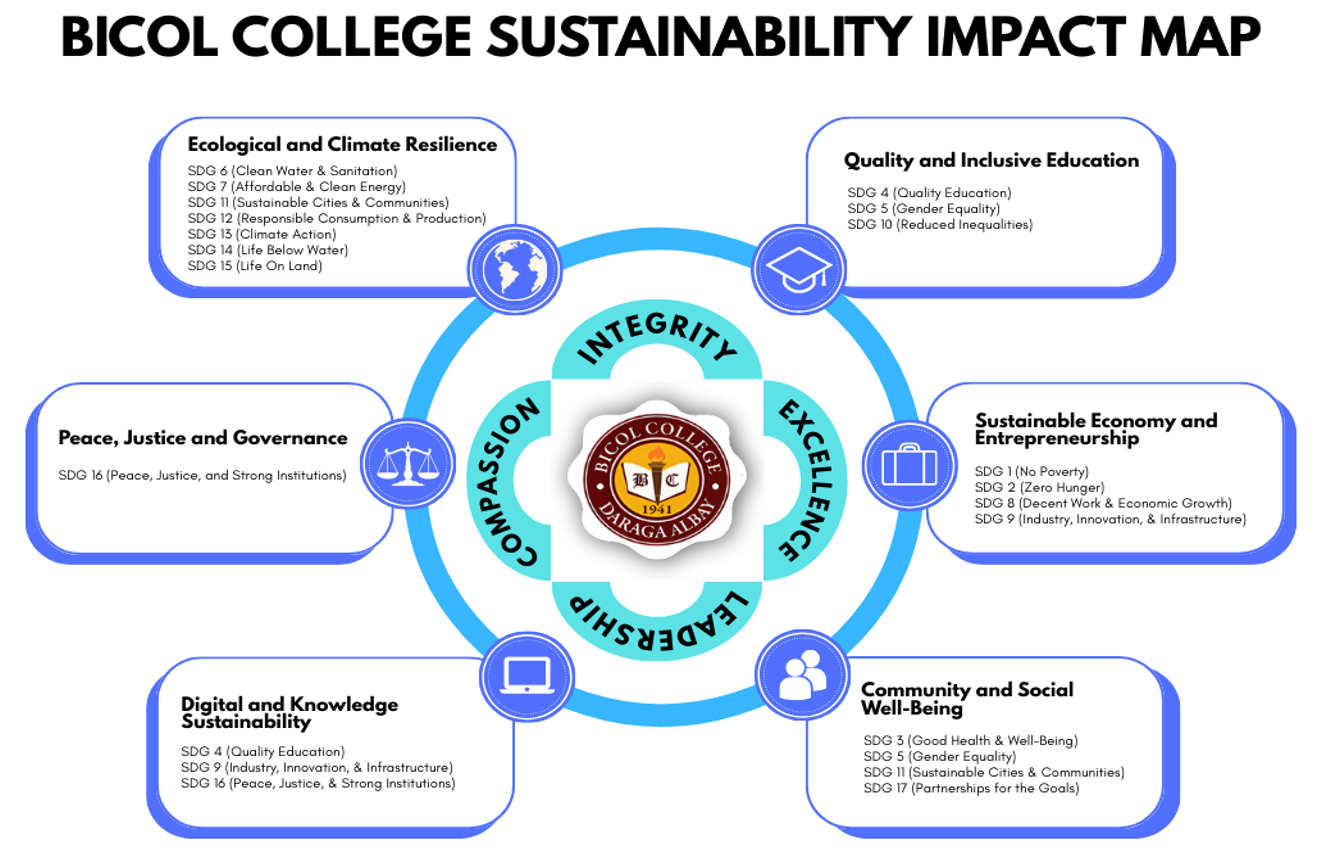
| Core Value | Sustainability Integration |
|---|---|
| Integrity | Ethical governance, transparency, academic honesty, rule of law, responsible research |
| Compassion | Inclusive education, community engagement, social protection, restorative justice |
| Excellence | Quality instruction, research productivity, innovation, global competitiveness |
| Leadership | Sustainable decision-making, public service, institutional and community leadership |
These values guide the College’s approach to sustainability across instruction, research, extension, and administration.
Demonstrate a strong theoretical understanding of concepts, approaches, and trends in research and teaching;
Design and implement strategies that are responsive to the needs of the 21st century schools and industry;
Apply quantitative and qualitative methods in conducting research;
Practice ethical behavior for organizational effectiveness, efficiency, and sustainability; and
Disseminate and utilize the major final output by target.
Lead in economic development and environmental security in the local and national level;
Produce advance competencies in:
Disseminate and utilize the major final output by target.
Advanced knowledge and skills in a specialized interdisciplinary, or multidisciplinary field of study for professional practice;
Self-directed research;
Lifelong learning with a substantial independence that involves individual work or teams of interdisciplinary or multidisciplinary experts; and
Application of the above skills in research, professional or creative works.
Advanced knowledge and skills in a specialized interdisciplinary, or multidisciplinary field of study for professional practice;
Pursue lifelong learning with a highly substantial degree of independence that involves individual work per terms of interdisciplinary or multidisciplinary experts;
Application of research, professional or creative work outputs to attain national and international standards; and
Disseminate and utilize the major final output by target.
Possess advanced and scientific knowledge and skills essential to the practice of Criminology (Criminal Sociology, Criminal Law and Jurisprudence, Law Enforcement Administration, Forensic Science, Criminal Investigation and Detection, and Correctional Administration);
Well-grounded, research-oriented and professional criminologists in the different areas of Criminology;
Creative and innovative in the administration of the criminal justice system in the implementation of laws, rules, regulations, policies and orders to address the needs of the community;
Strong network and linkages with national and global organizations for the prevention, control and solution of criminal offenses; and
Disseminate and utilize the major output to target agencies and beneficiaries.
SDG 16: Peace, Justice, and Strong Institutions – Demonstrate mastery of substantive and procedural laws, legal ethics, and advocacy skills to uphold the rule of law, access to justice, human rights, and effective legal institutions.
SDG 10: Reduced Inequalities – Provide inclusive, equitable, and rights-based legal services, particularly for marginalized and vulnerable sectors, through legal aid, public interest lawyering, and policy advocacy.
SDG 5: Gender Equality – Apply gender-sensitive legal analysis and practice in addressing discrimination, gender-based violence, and unequal access to justice.
SDG 17: Partnerships for the Goals – Engage in collaborative legal work with courts, government agencies, civil society organizations, and communities to strengthen justice systems and promote legal empowerment.
SDG 4: Quality Education – Pursue lifelong legal learning, critical legal research, and ethical professional development to adapt to evolving laws, jurisprudence, and global legal standards.
SDG 4: Quality Education – Demonstrate strong content knowledge, pedagogical competence, inclusive teaching strategies, and learner-centered practices to ensure equitable, quality, and lifelong learning for all.
SDG 5: Gender Equality – Promote gender-sensitive, culturally responsive, and inclusive education that respects diversity and supports equal participation and opportunities for all learners.
SDG 10: Reduced Inequalities – Implement differentiated instruction, inclusive education approaches, and learner support mechanisms to address diverse needs, including learners with disabilities, indigenous peoples, and marginalized groups.
SDG 16: Peace, Justice, and Strong Institutions – Model ethical behavior, professionalism, and responsible citizenship while integrating values education, peace education, and human rights in classroom instruction.
SDG 13: Climate Action – Integrate environmental education, disaster risk reduction, and climate change awareness into teaching practices, particularly in science, social studies, and community-based learning.
SDG 17: Partnerships for the Goals – Collaborate with parents, communities, local government units, and educational stakeholders to enhance learning outcomes and strengthen school–community partnerships.
For BEEd: Focus on foundational literacy and numeracy, child development, and inclusive early intervention; and strong integration of values education, environmental awareness, and community engagement
For BSEd: Emphasis on discipline-based mastery, critical thinking, research-informed teaching, and technology integration; and preparation for specialized instruction, curriculum design, and assessment in secondary education
SDG 16: Peace, Justice, and Strong Institutions – Apply criminological theories, laws, and criminal justice processes ethically to promote public safety, rule of law, human rights, and effective crime prevention.
SDG 11: Sustainable Cities and Communities – Contribute to safe, resilient, and inclusive communities through community-based policing, crime prevention strategies, and disaster preparedness and response initiatives.
SDG 5: Gender Equality – Promote gender-sensitive, victim-centered, and rights-based approaches in law enforcement, corrections, and criminal justice practices, particularly in addressing violence against women and children.
SDG 10: Reduced Inequalities – Advocate for fair, humane, and inclusive treatment of all individuals within the criminal justice system, including juveniles, indigenous peoples, persons deprived of liberty, and other marginalized sectors.
SDG 4: Quality Education – Engage in lifelong learning, research, and professional development to enhance competencies in criminology, forensic science, investigation, and public safety administration.
SDG 17: Partnerships for the Goals – Collaborate with law enforcement agencies, courts, correctional institutions, local government units, and communities to strengthen criminal justice systems and crime prevention programs.
SDG 8: Decent Work and Economic Growth – Apply ethical business practices, financial literacy, and management principles to promote productive employment, inclusive growth, and responsible enterprise development.
SDG 9: Industry, Innovation, and Infrastructure – Demonstrate innovation, entrepreneurship, and strategic thinking in developing competitive enterprises, leveraging technology and digital transformation.
SDG 12: Responsible Consumption and Production – Integrate sustainability, corporate social responsibility, and environmental stewardship in business operations, marketing, and supply chain management.
SDG 16: Peace, Justice, and Strong Institutions – Uphold good governance, transparency, accountability, and ethical leadership in organizational decision-making and business conduct.
SDG 17: Partnerships for the Goals – Build collaborative networks with industry, government, academe, and communities to support sustainable business initiatives and socio-economic development.
SDG 8: Decent Work and Economic Growth – Apply accounting, auditing, taxation, and financial reporting standards ethically to support transparent, inclusive, and sustainable economic growth.
SDG 9: Industry, Innovation, and Infrastructure – Utilize accounting information systems, digital accounting tools, and data analytics to enhance organizational efficiency, innovation, and financial decision-making.
SDG 12: Responsible Consumption and Production – Promote accountability, sustainability reporting, and responsible resource management through sound financial controls and environmental, social, and governance (ESG) accounting practices.
SDG 16: Peace, Justice, and Strong Institutions – Uphold integrity, compliance, and good governance by adhering to professional codes of ethics, regulatory frameworks, and anti-corruption measures.
SDG 8: Decent Work and Economic Growth – Create and manage sustainable enterprises that generate employment, promote inclusive growth, and support local and national economic development.
SDG 9: Industry, Innovation, and Infrastructure – Develop innovative products, services, and business models using creativity, technology, and research-based solutions to address market and societal needs.
SDG 12: Responsible Consumption and Production – Integrate sustainability principles, ethical sourcing, and circular economy practices in venture creation and business operations.
SDG 11: Sustainable Cities and Communities – Design entrepreneurial solutions that respond to community needs, support local industries, and contribute to resilient and inclusive communities.
SDG 17: Partnerships for the Goals – Establish collaborative networks with government, industry, academe, and civil society to strengthen entrepreneurial ecosystems and social impact initiatives.
SDG 8: Decent Work and Economic Growth – Apply ethical tourism and hospitality management practices that generate employment, support local livelihoods, and contribute to inclusive and sustainable economic growth.
SDG 12: Responsible Consumption and Production – Promote sustainable tourism practices, resource efficiency, and environmental stewardship in tourism operations, destination management, and visitor services.
SDG 11: Sustainable Cities and Communities – Develop and manage tourism products and destinations that preserve cultural heritage, protect natural resources, and enhance community resilience and well-being.
SDG 5: Gender Equality – Foster inclusive, gender-sensitive, and equitable workplaces within the tourism and hospitality industry, ensuring equal opportunities and respect for diversity.
SDG 17: Partnerships for the Goals – Collaborate with government agencies, local communities, industry stakeholders, and international partners to strengthen sustainable tourism development and destination competitiveness.
SDG 8: Decent Work and Economic Growth – Apply ethical hospitality management practices that promote decent work conditions, service excellence, and sustainable economic growth within the hospitality and service industries.
SDG 12: Responsible Consumption and Production – Implement sustainable hospitality operations through efficient resource management, waste reduction, food sustainability, and environmentally responsible service practices.
SDG 5: Gender Equality – Foster inclusive, gender-sensitive, and equitable workplaces in hospitality establishments, ensuring equal opportunities, fair treatment, and respect for diversity.
SDG 11: Sustainable Cities and Communities – Contribute to community-based hospitality initiatives that support cultural preservation, local employment, and sustainable urban and rural tourism development.
SDG 17: Partnerships for the Goals – Collaborate with industry partners, local government units, communities, and international stakeholders to enhance service quality, innovation, and sustainable hospitality development.
SDG 16: Peace, Justice, and Strong Institutions – Analyze political systems, public policies, and governance processes to promote democratic participation, rule of law, transparency, accountability, and effective public institutions.
SDG 10: Reduced Inequalities – Advocate inclusive public policies and political processes that address social, economic, and political inequalities affecting marginalized and underrepresented sectors.
SDG 5: Gender Equality – Apply gender-sensitive political analysis and support policies that promote women’s participation, representation, and leadership in governance and decision-making.
SDG 11: Sustainable Cities and Communities – Contribute to policy formulation and governance strategies that support sustainable urban development, community resilience, and participatory local governance.
SDG 17: Partnerships for the Goals – Engage with government institutions, civil society organizations, international bodies, and communities to strengthen policy advocacy, governance reforms, and development cooperation.
SDG 4: Quality Education – Demonstrate critical thinking, research competence, and lifelong learning in political science to inform evidence-based policy making and civic education.
SDG 9: Industry, Innovation, and Infrastructure – Design, develop, and deploy innovative computing solutions, algorithms, and systems that support digital transformation, technological advancement, and resilient infrastructure.
SDG 8: Decent Work and Economic Growth – Apply computing and software engineering competencies to enhance productivity, create technology-driven employment opportunities, and contribute to inclusive economic growth.
SDG 12: Responsible Consumption and Production – Promote sustainable and energy-efficient computing practices, responsible use of digital resources, and environmentally conscious system design.
SDG 16: Peace, Justice, and Strong Institutions – Uphold ethical computing, data privacy, cybersecurity, and responsible use of technology to support trustworthy digital systems and strong institutions.
SDG 4: Quality Education – Engage in lifelong learning, research, and innovation in computer science to adapt to rapidly evolving technologies and global digital standards.
SDG 17: Partnerships for the Goals – Collaborate with industry, government, academe, and communities in developing technology-based solutions for social good and sustainable development.
SDG 4: Quality Education – Provide equitable access to information resources, support lifelong learning, and promote information literacy, research skills, and knowledge creation.
SDG 16: Peace, Justice, and Strong Institutions – Uphold intellectual freedom, ethical information management, transparency, and responsible stewardship of information in libraries, archives, and information centers.
SDG 10: Reduced Inequalities – Ensure inclusive information services that address the needs of marginalized groups, including persons with disabilities, indigenous peoples, and underserved communities.
SDG 9: Industry, Innovation, and Infrastructure – Apply information and communication technologies, digital libraries, and knowledge management systems to support innovation and resilient information infrastructure.
SDG 11: Sustainable Cities and Communities – Preserve cultural heritage, local knowledge, and documentary records that contribute to community identity and sustainable cultural development.
SDG 17: Partnerships for the Goals – Collaborate with educational institutions, government agencies, cultural organizations, and communities to strengthen information services and knowledge-sharing networks.
The Graduate School of Bicol College serves as a center for advanced scholarship, leadership formation, and policy-oriented research aligned with the Sustainable Development Goals (SDGs). Distinct from undergraduate programs, graduate education emphasizes systems thinking, evidence-based decision-making, ethical governance, and transformational leadership in education, criminology, and management.
Graduate programs are designed to develop scholar-leaders who can influence institutions, communities, and public policy toward sustainable, just, and inclusive development.
Advanced leadership for schools, higher education institutions, and learning systems
Policy design, curriculum reform, and quality assurance
Inclusive, gender-responsive, and equitable education
Master of Arts in Education (MAEd) Specialization in Educational Administration, Filipino and Mathematics
Master in Education (M.Ed) specialization in Curriculum and Instruction and Language Education
Doctor of Education (EdD) major in Educational Management
Strategic leadership in crime prevention, law enforcement, and restorative justice
Evidence-based criminological research
Ethical decision-making in public safety institutions
Master of Science in Criminal Justice (MSCJ) Specialization- Criminology
Sustainable organizational leadership and governance
Innovation, entrepreneurship, and responsible management
Corporate social responsibility and ethical decision-making
PhD in Management
Master in Management (MBA/MPA)
Sustainable organizational leadership and governance
Interdisciplinary and applied research
Knowledge generation for policy, practice, and community transformation
All Graduate Programs
Educational leadership, governance, and reform
Crime prevention, justice systems, and community safety
Sustainable management, innovation, and organizational ethics
Digital transformation, data ethics, and knowledge management
Community resilience and social development
Policy fora, colloquia, and leadership seminars
Community-based and industry-linked research
National and international research collaborations
Publication, presentation, and knowledge dissemination
These initiatives prepare graduates to assume leadership roles as educational leaders, senior managers, policymakers, researchers, and change agents committed to sustainable development.
Research-driven and policy-oriented approach
Strong alignment with SDGs and national development goals
Integration of ethics, governance, and sustainability leadership
Emphasis on real-world impact and institutional transformation
To ensure accountability and continuous improvement, the Graduate School adopts the following Sustainability & Leadership Key Performance Indicators (KPIs):
| Area | Key Indicators |
|---|---|
| Academic Excellence | % of SDG-integrated graduate courses; curriculum innovations approved, book authorship. |
| Research Impact | SDG-aligned theses/dissertations; publications; policy briefs, Research Utilization. |
| Leadership Formation | Graduates in leadership roles; leadership seminars conducted; speakership. |
| Community Engagement | Community-based research projects implemented; beneficiaries served. |